
A few months ago, a homeowner in Streatham called us for some advice. She was building a rear extension — a new open-plan kitchen with big sliding doors — and she’d already had a full set of drawings prepared by her architect. Those drawings specified everything: the type of insulation, the size of the steel beams, even the membrane that goes behind the render.
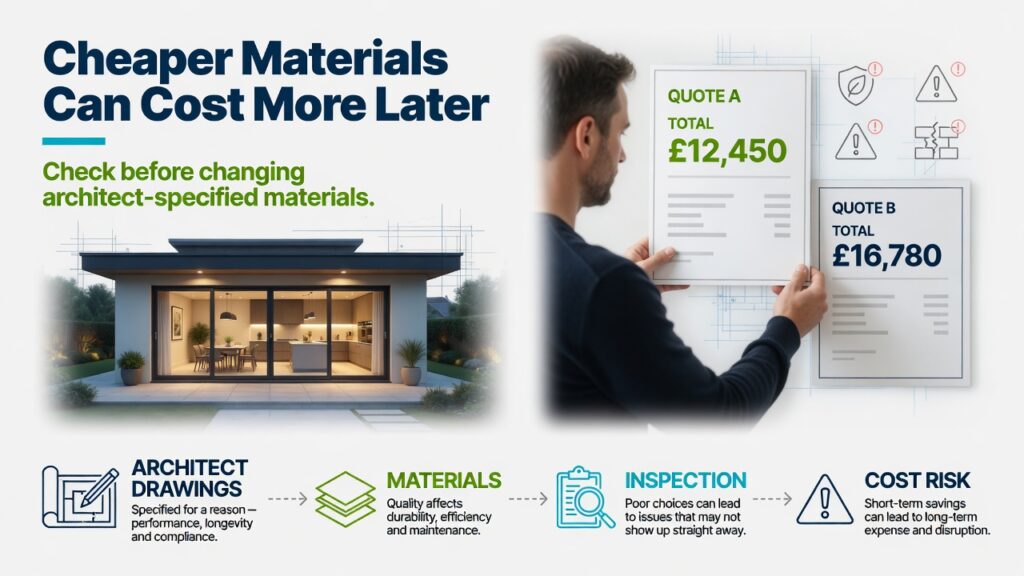
Then another builder came to quote. He looked over the plans and told her she didn’t need all of that. He could use cheaper materials instead and save her a few thousand pounds. To most people that sounds like a sensible offer, and she nearly accepted it. She rang us for a second opinion first, and we’re glad she did, because that “saving” would almost certainly have cost her far more in the end.
This is one of the most common misunderstandings we come across in home building, so it’s worth explaining properly.
Why the materials on your drawings are chosen so carefully
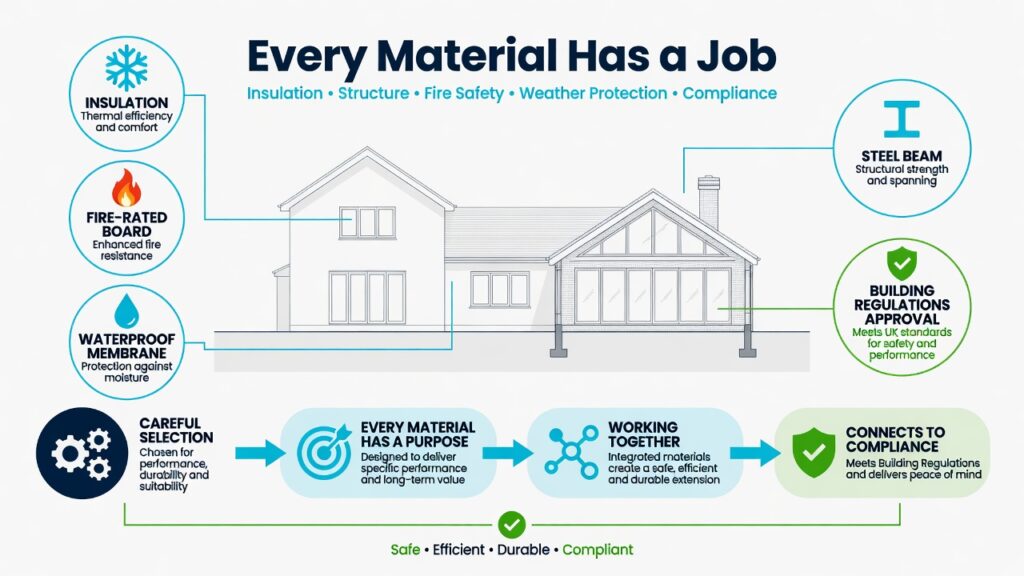
When an architect or designer writes down a specific material, they are not simply picking something they like the look of. Each material has been chosen to do a particular job, and most of those jobs are tied directly to the Building Regulations — the legal standards every building has to meet.
The insulation, for example, is a certain thickness because the finished room has to reach a set level of warmth and energy efficiency. The steel beams are a specific size because a structural engineer calculated exactly how much weight they need to carry. The fire-rated boards are rated because of where they sit in the building. Everything on the drawings works together as a single, connected design.
When a builder swaps one of those materials for a cheaper “similar” product, they are not just changing a single item. They are changing the design, and very often breaking the chain of calculations that the whole project depends on. The problem is that Building Control — the inspector whose job is to sign the work off — checks the building against the approved drawings. If what is actually on site doesn’t match, the work can be refused.
What that cheaper quote could really have cost
It helps to look at what would likely have happened if our Streatham client had accepted the cheaper materials, because the true cost is rarely mentioned at the quoting stage.
The first risk is a failed inspection. If the inspector finds materials that don’t meet the required standard, they can refuse to approve the work. At that point you may have to take apart finished work and redo it correctly — at full price, plus the delay and the stress.
The second risk appears years later, when you come to sell. Your buyer’s solicitor will ask for the completion certificate that proves the work was signed off. If the paperwork isn’t clean, the sale can stall, and a surveyor will often spot the issue.
The third cost is the quietest one. Cheaper insulation usually performs worse, which means a colder room and higher heating bills for as long as you own the house. The few thousand pounds “saved” at the start slowly leaks back out through the walls, winter after winter.
There is a right way to save money
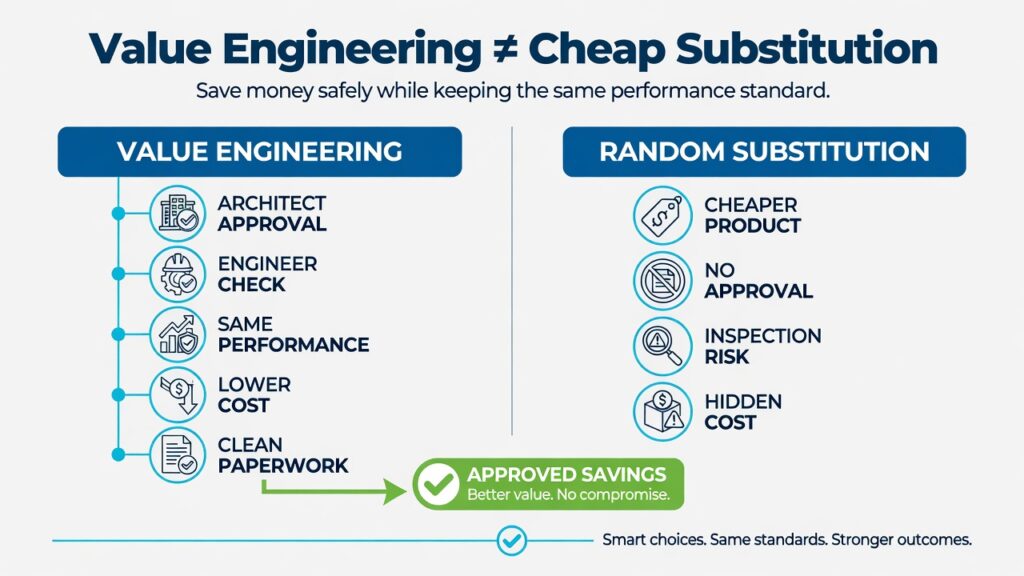
None of this means you have to accept the most expensive option for everything. Saving money is perfectly possible — it just has to be done in a way that still meets the standard. In the trade we call this value engineering, and it’s something we build into every project at the design and planning stage.
The difference is simple. Proper cost-saving finds a cheaper way to achieve the same result, checked and signed off by the design team. Random substitution just picks a cheaper product and hopes it passes. The first protects you; the second gambles with your money.
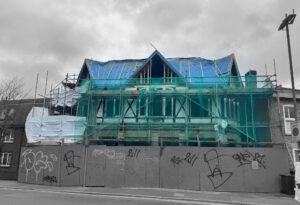
In practice, sensible savings tend to come from a handful of places. Sometimes there’s a more affordable way to build up a wall or floor that still hits the same warmth target. Sometimes the structural design can be simplified early, with the engineer, before any steel is ordered. Often the biggest savings come simply from getting the builder involved while the drawings are still being prepared, so cost is planned in from the beginning rather than cut out in a hurry later on. You can see this approach across our residential projects, including our current build on Streatham High Road.
Why this matters even more from 2026 onwards
There’s also a timing reason to get this right. The new Future Homes Standard is raising the bar on how warm and energy-efficient homes must be, which puts insulation and fabric under closer scrutiny than ever. On larger projects there is now also a legal duty, under the Building Safety Act, to keep a clear record of exactly which materials went into a building.
In other words, quietly substituting whatever happens to be cheapest is no longer an option that anyone can get away with. The materials need to be correct, and you need to be able to prove that they were.
How we would handle your project
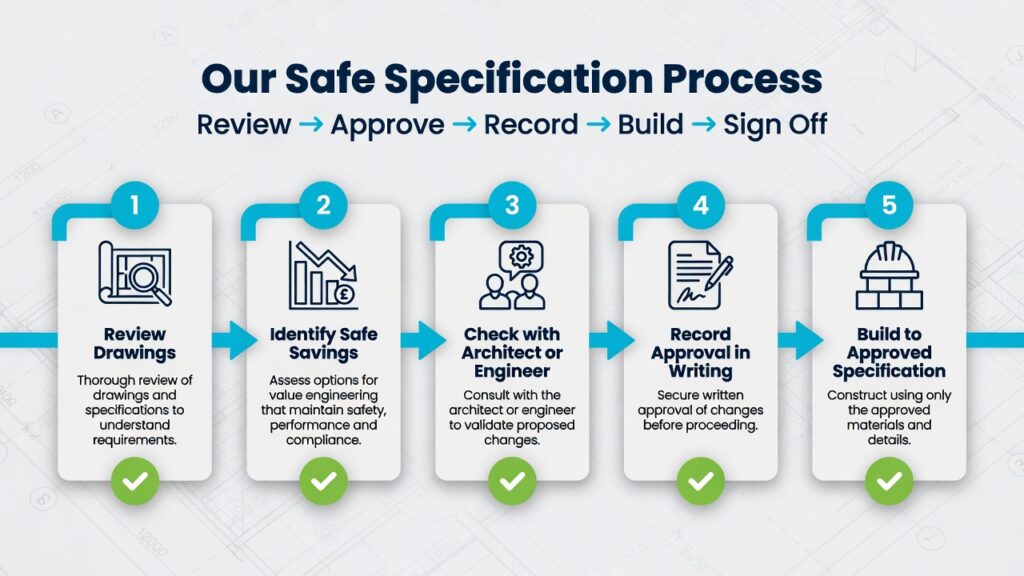
When you build with us, your drawings are treated as the agreement they really are. If we genuinely believe there is a cleverer, more affordable way to achieve something, we will raise it with you — but we will have it approved in writing by your architect or engineer first, so your paperwork stays clean and your build stays compliant. That way there are no surprises at inspection and no awkward problems when you sell.
Our Streatham client went ahead with the proper specification, saved money the sensible way, and finished with a warm, fully signed-off extension she can sell without any complications. That is exactly how it should work.
So if you have drawings prepared and you’re looking at two very different quotes, wondering why one is so much cheaper, that gap is usually the answer. We’re always happy to review a specification before you commit to anything. As Federation of Master Builders members with full ISO and FORS accreditation, getting it right on paper and on site is simply how we work.
Send us your drawings for an honest second opinion →
Frequently Asked Questions
Can a builder change the materials my architect specified? Only with your architect’s or engineer’s written approval. The materials are tied to the Building Regulations, so changing them without sign-off can fail your inspection, void warranties and cause problems when you sell. Any change should be agreed and recorded before work begins.
Will I really fail a Building Control inspection for using cheaper materials? You can. The inspector checks that the work on site matches the approved drawings. If a cheaper material doesn’t perform as required — for example insulation that’s too thin to reach the warmth target — the work may not be approved until it’s corrected.
What is value engineering, and is it just a polite term for cheaper materials? No. Value engineering finds a more affordable way to reach the same result, agreed with your design team. Simply buying a cheaper product and hoping it passes inspection is substitution, and that’s usually where the problems start.
How much can I realistically save without risking the build? It depends on the project, but genuine savings usually come from smarter design, sensible timing and efficient build-ups, decided early with your builder involved. Send us your specification and we’ll show you where the safe savings are.
Do these issues apply to extensions in Streatham and South London? Yes. The Building Regulations apply across England, including Lambeth and the wider South London area. We carry out residential projects across Streatham, Clapham, Balham, Tooting and nearby areas.